The print and mail industry has a bad habit: it loves acronyms. Then it blurs them until nobody is sure where one category ends, and the next starts.
That is exactly what has happened with CCM, ADF, and ECP.
Vendors collapse them together. Buyers inherit the confusion. RFPs use the terms loosely. Product pages stretch language to fit whatever category sounds broadest or easiest to explain. The result? Misunderstanding the category and buying the wrong type of solution.
Start with CCM
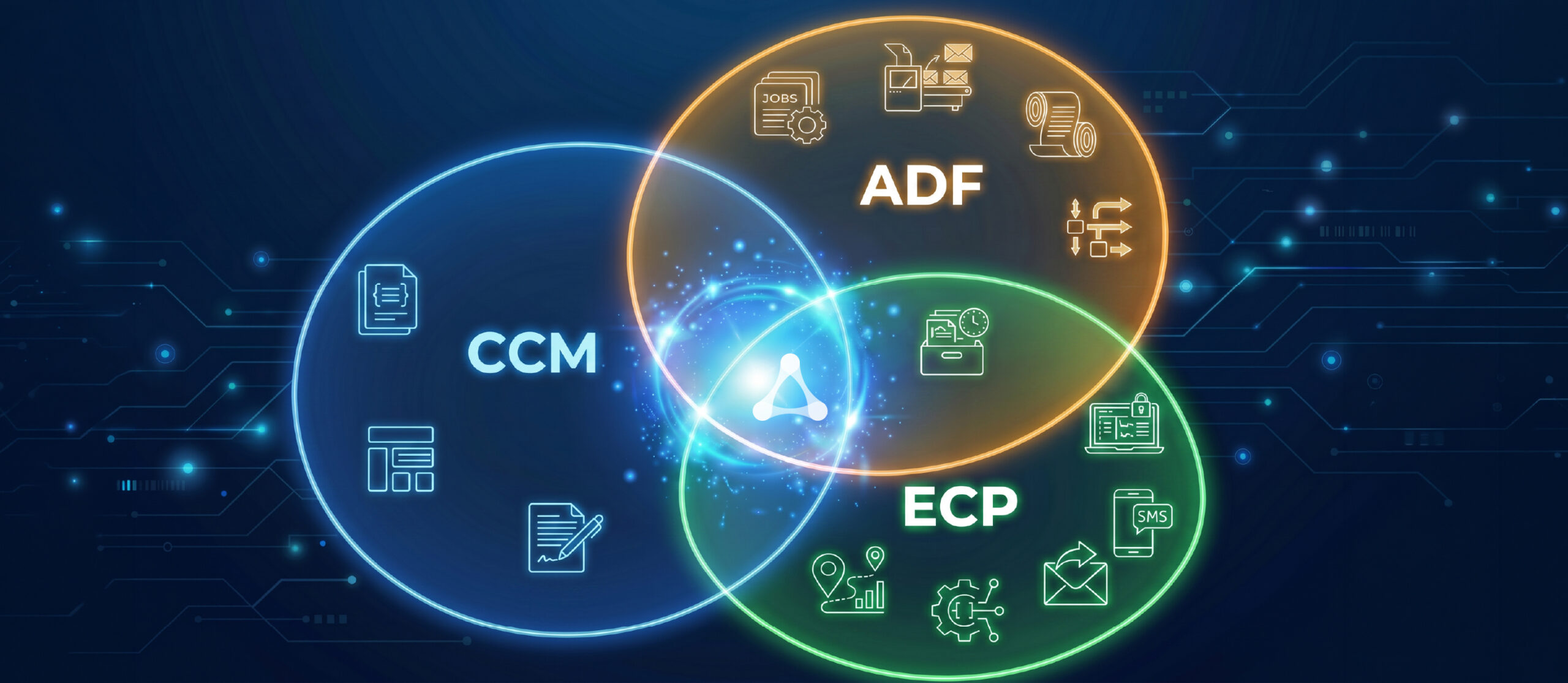
CCM (Customer Communications Management) is about creating communications. Templates, content assembly, business rules, composition logic, and generation of customer-facing documents like statements, invoices, notices, letters, and regulated correspondence.
If your main question is “How do we create the communication?” you are talking about CCM.
Composition is foundational, and utilizing a versatile composition tool is often the first step in that journey. But composition is not the same thing as operational control. A platform can excel at building communications and still leave huge downstream gaps around batching, workflow, archive, delivery coordination, or status visibility.
That’s where buyers get into trouble: assuming document creation equals communications control. It doesn’t.
Now ADF
ADF (Automated Document Factory) lives closer to the production side. It automates and manages the preparation, processing, and movement of high‑volume documents through operational workflows.
Think digital prep steps, production orchestration, advanced print management, inserting, mailing, status capture, and workflow controls between business intake and final output.
If your question is “How do we move large volumes through production with less friction and more control?” you are in ADF territory.
This is the space where terms like run-time decisions, device coordination, job management, production visibility, batch efficiency, postal savings, reprints, multi-site routing, and physical mail workflow all become part of the conversation. ADF matters because many operations are still trying to manage factory-level volume with office-style tooling. That works right up until it doesn’t.
And then there is ECP
ECP (Enterprise Communications Processing) is the layer many organizations need but don’t always have a name for.
It sits between document creation and final delivery, handling what happens after composition. By leveraging specialized integration solutions, it manages post-composition processing, format transformation, and cross-channel orchestration, archive support, tracking, suppression, hold‑and‑release logic, and handoffs into other systems.
If your question is “How do we control what happens after composition across print, digital, archive, and downstream systems?” that is ECP.
Think of it this way:
- CCM creates the message.
- ADF automates production.
- ECP orchestrates what happens next.
It’s not a perfect model, but it’s a clear and practical way to understand the flow.
Where the Confusion Starts
The categories overlap. Of course they do.
A modern communications stack often includes all three. Some platforms span multiple layers. Some vendors use labels loosely. Some products evolved faster than their positioning. Read too much generic website copy and it can seem like every platform is doing the same thing under different branding, but that’s not the case.
The better question is not “Which acronym sounds right?” but “Where are we losing control today?”
- If the challenge is document design and composition, you need CCM.
- If the challenge is moving high‑volume work through print and mail production, you need ADF.
- If the challenge is downstream orchestration, archive, multichannel delivery, post‑composition changes, and operational visibility across systems, you need ECP.
In practice, many large organizations need all three. The real issue is identifying which layer is missing or weakest.
Why ECP Deserves More Attention
For many buyers, this is the most useful correction.
Most enterprises already have composition in place, whether legacy platforms, line‑of‑business systems, custom applications, or CCM suites. One way or another, the document gets created.
The pain begins after that.
Operations need to add barcodes, reformat files, suppress print for digital recipients, post records to a portal, archive final communications, route work across facilities, hold jobs to improve postal density, feed document status into CRM or service tools, and prove what happened when compliance starts asking questions.
That is not simply output management. And it is certainly not just composition.
This is where ECP earns its keep, by orchestrating everything that happens downstream, ensuring control, visibility, and compliance across the communication lifecycle.
Where post-composition fits
Post-composition is one of the clearest examples of why ECP matters.
A business user needs to update a document, but nobody wants to touch the legacy code. Or the composition team is overloaded. Or the original application is brittle. Or the change is operational, not editorial.
In those cases, the smartest move is often to modify the document after it has already been composed. That can mean adding a barcode, shifting an address block, inserting a hyperlink, removing or masking content, adding pages, changing color, or applying logic to a completed PDF so it can move downstream more cleanly.
That is not a side feature. It is a huge operational advantage.
It cuts IT dependency. It speeds up change. It reduces risk in legacy environments. It gives production teams more control over the outcome without asking them to re-engineer the application upstream.
The overlap between categories is where platforms often distinguish themselves. Alchem‑e is a good example.
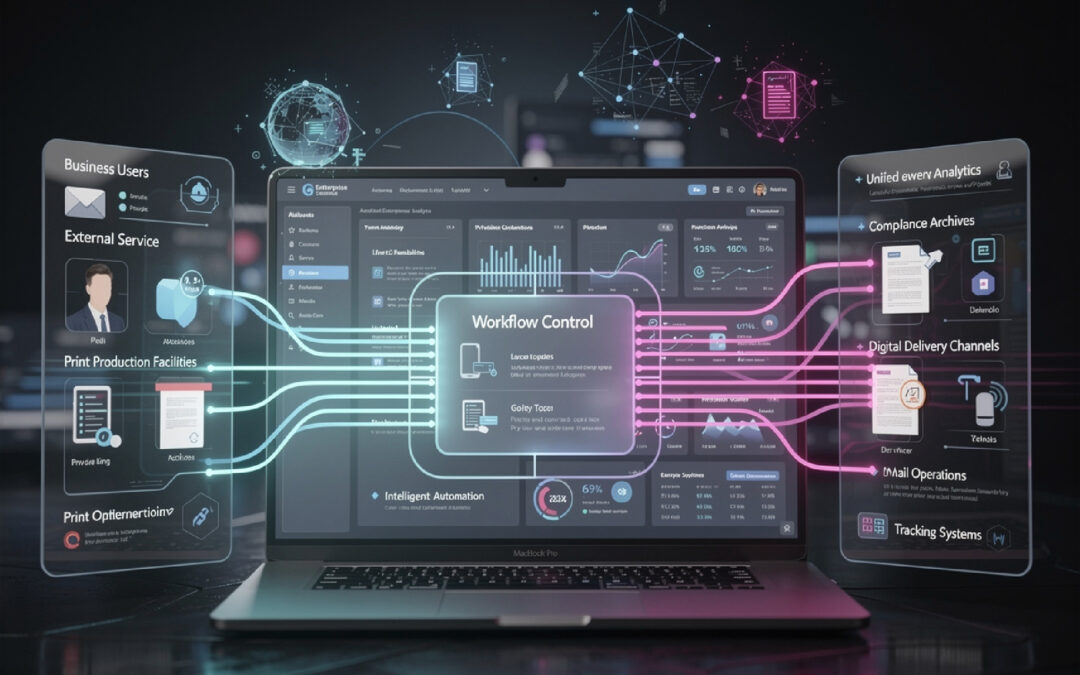
While Racami’s broader suite includes composition capabilities, the distinctive strength of Alchem‑e shows up in orchestration, workflow, post‑composition control, tracking, batching, print and digital coordination, archive support, and integration with other business systems.
That places it closer to the intersection of ADF and ECP, where operational control and downstream visibility matter most.
Seen through that lens, the pieces line up naturally:
- Controls high‑volume processing workflows with batching for maximum throughput
- Supports run‑time decisions without reopening composition logic
- Enables document re‑engineering after composition
- Provides archive and digital presentment support
- Exposes data to other systems through APIs and integrations
- Improves visibility into jobs, pieces, and workflow status
- Supports disciplined promotion and testing before changes reach production
This is not generic CCM software. It is infrastructure for customer communications operations, the kind of capability the category has been missing.
A cleaner buying lens
If you’re evaluating platforms, stop chasing labels. Ask instead:
- Where is the breakdown happening today?
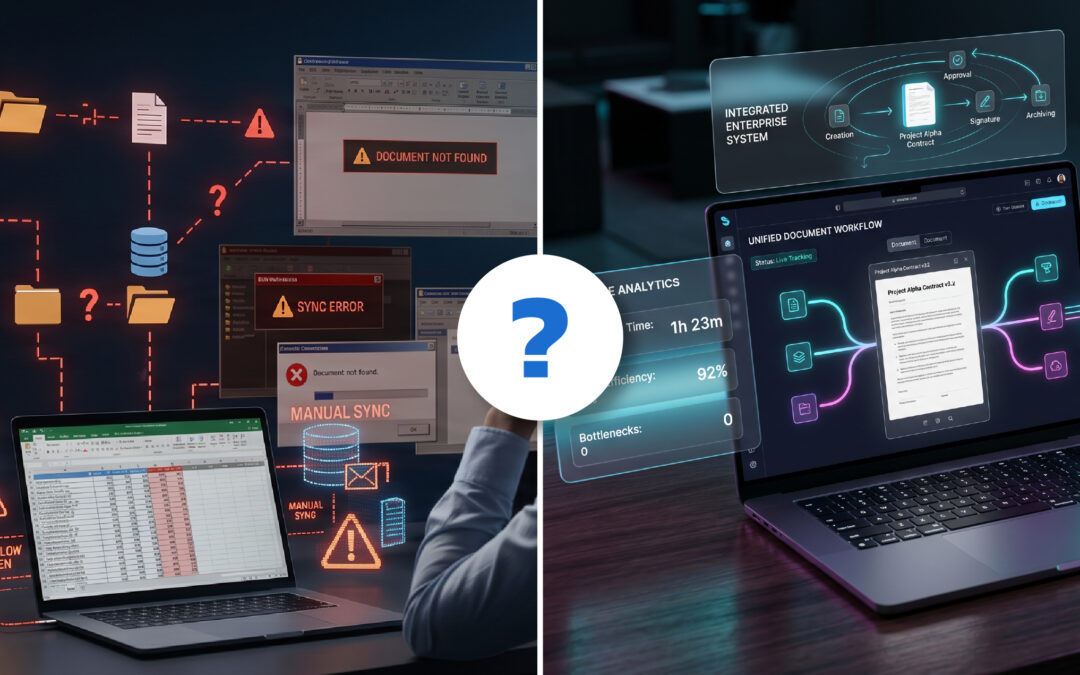
- Are we struggling to create communications, or to control them after creation?
- Do we have too much manual work in production?
- Can we support both print and digital from the same operating model?
- Can customer service, compliance, and operations all get to the same truth?
- Can we change downstream documents without putting every request on IT’s back?
Those questions will get you closer to the right architecture than a dozen acronyms ever will.
Final thought
CCM, ADF, and ECP are not interchangeable. They solve different problems, even when they overlap.
The real mistake is pretending one category can carry the whole load.
In today’s print and mail environment, the winners aren’t the companies that only compose beautifully. They’re the ones that control what happens after composition, through production, across channels, and into the systems that run the business.
Build a Better Communication Infrastructure
Knowing the difference between these categories is the first step, but the next is seeing exactly where they fit within your specific operation. If you are ready to move beyond industry acronyms and start building a more resilient workflow, click the button below to schedule a strategy session with our team.
FAQs
What is an ADF system?
An Automated Document Factory, or ADF, is a production-oriented environment that automates high-volume document preparation, processing, print workflow, physical production steps, and operational tracking.
What is the difference between CCM and ECP?
CCM focuses on creating and composing customer communications. ECP focuses on what happens after composition, including transformation, archive, multichannel delivery, tracking, and downstream workflow control.
Can one platform cover CCM, ADF, and ECP?
Sometimes. Some platforms span parts of multiple categories, and many enterprises use multiple systems together. The more important question is which layer is weak or missing in your environment today.
Why is post-composition so important?
Post-composition lets teams make downstream changes after a document has already been created. That reduces IT dependency, speeds up change, and helps organizations improve production, archive, and delivery workflows without constantly editing legacy composition systems.
Where does Alchem-e fit?
Alchem-e is best understood as an ADF and ECP-style orchestration platform with capabilities that support workflow control, tracking, post-composition processing, archive support, print and digital coordination, and external integrations.