
OPINION & EDITORIAL
Matt Mahoney, COO, Racami
Every few decades, something comes along that fundamentally changes productivity.
The steam engine did it for manufacturing.
Computers did it for office work.
The internet changed communication and commerce.
I think artificial intelligence is the next step in that progression. But despite all the excitement around AI right now, I keep coming back to something simple:
The basic economics of business have not changed.
Companies still succeed when they create something useful that someone else is willing to pay for. That simple exchange is still the miracle of a free market.
AI does not change that.
What it changes is how efficiently we can create and deliver value. I see that playing out very clearly right now in Customer Communications Management (CCM).
I Tend to Look at AI Through an Economic Lens
I probably think about AI a little differently than most people. I do not start with the technology. I start with productivity. If you look at it from an Economist point-of-view as the engine of growth, when productivity goes up, the same number of people can produce more output.
That is what AI is doing. You can see it most clearly in software development.
At a recent conference, we showed a room full of executives something that would have sounded unrealistic two years ago. Using tools like Cursor, we worked on a customer-facing dashboard live in front of them.
We changed it on the fly. The AI wrote the code, structured the components, and helped validate the logic.
What really landed with people was this: it was not a prototype. It was working software that could actually be deployed. You could feel the room shift when that clicked. Because what people are seeing now is not just automation. It is compressed development cycles.
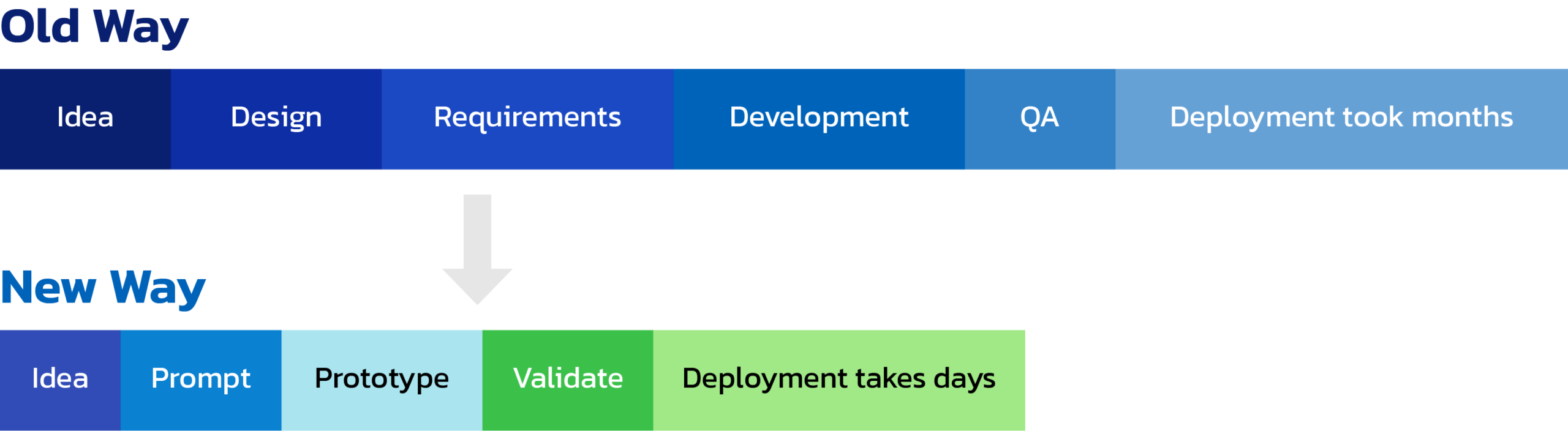
That shift has major implications for enterprise software in general and CCM in particular.
CCM Has Always Been About More Than Documents
In my experience, CCM has never really just been about generating documents. It’s a collection of efforts around operations, compliance, and customer experience.
Most of what we are dealing with in CCM is transactional communication:
- Monthly billing statements
- Explanation of benefits
- Policy notices
- Government correspondence
- Account updates
- Regulatory disclosures
These exist because business processes require them.
They have to be accurate.
They have to be compliant.
They have to go out on time.
For decades, organizations invested heavily in CCM platforms to manage all of that at scale. Marketing teams, somewhere along the way, realized transactional documents are valuable touchpoints with customers. Unlike marketing emails that are often ignored, statements get opened. They get read. People spend time with them. That made them prime real estate for engagement. So CCM lives in this blended world between operations and marketing, and that is where AI starts changing things.
AI Changes the Economics of Personalization
Historically, personalization in CCM was expensive. If you wanted to change messaging, add dynamic content, or introduce new segmentation logic, it meant development time, testing cycles, template updates, and workflow changes. Every improvement came with real cost and time.
AI changes that.
When development cycles compress, the cost of experimenting drops dramatically. Organizations can now test messaging strategies, offers, and personalization approaches much faster and much more often. From an economic standpoint, AI lowers the marginal cost of improvement.
That changes how I think organizations will approach customer communications going forward. Instead of treating statements as static documents updated once a year, they start treating them as dynamic engagement channels that evolve continuously.
The Question I am Contemplating: Why Pay for CCM Software at All?
If AI can build applications this quickly, why would companies keep paying for CCM platforms?
In theory, you could imagine prompting an AI agent to build your own communications system from scratch. But in the real world, the economics might not be obvious. Organizations are not just paying for software. They are paying for reliability, risk reduction, and experience. Customer communications operate in environments where mistakes are expensive.
A billing error triggers complaints.
A healthcare mistake creates compliance exposure.
A production issue can impact millions of customers overnight.
So, the real question is not whether AI can generate code. The real question is who owns the responsibility for making sure the system works correctly every single day.
That is where CCM platforms still matter. They embed years of operational experience into things like document composition, postal optimization, compliance workflows, auditability, and large-scale production handling. Those are not just features. They are operational disciplines baked into software.
What I see happening instead is a shift. AI will make it easier to build everything around the platform. Dashboards, integrations, and automation will get much easier. But the platform itself increasingly becomes something else. It becomes infrastructure.
AI Is Already Changing CCM Operations
Beyond personalization, I see AI reshaping operations in practical ways.
We are already seeing progress in areas like:
- Document Ingestion
AI can interpret incoming files and prepare workflows automatically. - Workflow Automation
AI agents can design and refine production workflows much faster than traditional approaches. - Quality Assurance
AI can validate documents at a scale manual processes cannot match. - Operational Visibility
Dashboards can be built and refined continuously instead of once a year.
- Document Ingestion
The result is simple. Operations get faster, cleaner, and more transparent.
AI Does Not Replace Discipline
One thing I think people get wrong is the idea that AI eliminates the need for structure or governance. In my experience, it actually increases the need for discipline. CCM often operates in regulated industries like healthcare, insurance, government, and financial services. Communications must meet strict standards around accuracy, privacy, and compliance.
AI accelerates development, but it still needs guardrails. Your people can vibe code a lot of things without oversight because it’s so easy, maybe too many things. The organizations that succeed will be the ones that combine AI-driven productivity with strong operational discipline.
Where I Think CCM Platforms Go From Here
When I think about the future of CCM platforms, I do not see them going away. I see them evolving. AI will absolutely make it easier for companies to build pieces of what CCM platforms traditionally delivered. Some organizations will experiment with building their own tools. A few will succeed in narrow cases. But if you step back and look at the economics, I think the long-term value of platforms actually becomes clearer.
CCM is not just about generating documents. It is about running communications operations at scale. That includes orchestration, governance, tracking, reconciliation, and compliance across millions of communications and multiple channels. Those are not one-time development problems. They are daily operational realities.
As AI makes development faster, companies will send more communications across more channels, with more personalization and faster cycles. That increases the need for centralized control and visibility. And risk still matters. If you are sending millions of statements or regulatory notices, mistakes are expensive. The economics favor platforms that build safeguards into the process.
So, here is what I think happens:
Historically, CCM platforms were seen mostly as software tools. Going forward, they are increasingly viewed as operational infrastructure. AI will handle more development around the edges. But the platform becomes the control layer that governs how communications are produced, tracked, delivered, and measured. The companies that win in this space will not try to compete with AI. They will incorporate it intelligently while continuing to solve the operational problems customers actually care about. Because at the end of the day, organizations are not buying CCM software just to generate documents, print, and distribute them. They are buying confidence that their most important communications go out correctly, consistently, and on time.
The Market Still Decides
Despite all the change, one thing stays the same. Markets reward organizations that create value. AI does not replace that principle. It just gives us better tools to deliver value faster and more precisely.
For organizations managing high-volume communications, the opportunity is huge. Statements and notices have always been necessary. Now they can also be smarter, more personalized, and more useful to customers, and in the end, that is what matters most. Because the real miracle is not the technology. It is still what it has always been: Creating something useful that someone else is willing to pay for.