
Every month, enterprise organizations send millions of customer communications that carry legal, financial, or operational consequences. Utility bills, insurance notices, tax statements, policy updates, and healthcare correspondence all depend on one assumption: every communication reaches the right person, at the right time, with a complete record proving it happened.
Consider a regional health insurer responding to customer complaints about missing regulatory notices. The internal operations team confirms the files were generated correctly and transmitted to the print provider on schedule. The print provider verifies that production completed successfully. Yet when auditors request proof of what happened to individual notices, neither organization can produce a single, uninterrupted audit trail from data generation through final delivery.
Nothing “failed” in the traditional sense. The data was correct, the equipment worked, and the vendors met their service-level agreements. Even so, no one could see the entire communications journey from data generation through final delivery because there was no centralized operational view.
This scenario illustrates a growing challenge across enterprise customer communications. As organizations distribute production across internal teams, service providers, cloud platforms, and digital delivery channels, operational visibility often becomes fragmented. The organizations that manage this complexity most successfully are not necessarily those that insource production or outsource it. They are the ones that retain centralized control over workflows, business rules, audit evidence, and customer communication history, regardless of where production occurs.
The Traditional Sourcing Debate No Longer Fits Modern Operations
For years, organizations approached print-and-mail sourcing as a straightforward procurement decision.
Should production remain in-house for greater operational control? Or should it be outsourced to a service provider that offers economies of scale, production capacity, and postal optimization?
When customer communications consisted primarily of predictable monthly statements produced by a single print facility, that question made sense. Internal print centers provided direct oversight of equipment, staff, and production schedules. External providers reduced capital investment while offering high-speed equipment and mailing expertise.
Today’s communications environments are far more distributed.
A single regulated document may pass through multiple systems before reaching the customer:
- Enterprise applications generate transaction data
- Composition software creates personalized communications
- Business rules determine delivery preferences
- Files move through ETL or normalization processes
- Production is distributed across one or more print providers
- Digital notifications may be sent simultaneously
- Final communications must be archived for compliance and customer service
Each additional handoff creates another opportunity for tracking gaps, delayed exception handling, or inconsistent business rules.
The sourcing question has therefore changed.
Instead of asking whether production should be insourced or outsourced, operations leaders should ask:
Which parts of our communications workflow must remain under enterprise control, and which execution tasks can safely be delegated?
Physical production can be outsourced.
Regulatory accountability cannot.
Hybrid Operations Create New Blind Spots
Many organizations adopt hybrid production models because they offer the best of both worlds.
Internal teams maintain ownership of customer data, compliance policies, and communication strategy. External providers contribute specialized production expertise, regional facilities, mailing optimization, and scalable capacity.
Hybrid production offers organizations more flexibility, but every additional system, vendor, and delivery channel also introduces another opportunity for visibility gaps. Those gaps often don’t become apparent until production issues arise.
Consider a common enterprise environment where one department owns document templates, another manages customer data, a third-party provider handles print and mail production, a separate vendor delivers digital communications, and an archive system stores historical communications. Each system performs its assigned task. The problem is that very few organizations maintain a single operational view across all of them.
When production exceptions occur, teams often rely on emails, spreadsheets, vendor portals, production logs, and support tickets to reconstruct what happened. Rather than creating resilience, this fragmented approach often makes it harder to understand what happened when production issues occur.
Vendor Success Does Not Equal Enterprise Visibility
One misconception continues to shape sourcing decisions.
Organizations often assume that hiring reliable vendors automatically provides complete operational transparency. In reality, each vendor reports only on the portion of the workflow it manages. A print provider can confirm when files entered production, a mailing provider can report postal induction, and a digital platform can verify message delivery. What none of these systems can do independently is verify the complete lifecycle of every communication across every participant in the workflow.
Consider a billing file split between two production facilities. One facility completes production successfully, while the second encounters a barcode validation failure affecting only a small subset of mail pieces. Each provider can accurately report on its own environment, but without centralized orchestration, identifying the affected customers may require manual reconciliation across multiple systems. Neither vendor is necessarily at fault. The visibility gap exists because no single system owns the entire communications workflow.
Operations teams should be able to answer questions like these immediately:
- Which files were scheduled for production today?
- Which documents completed every processing step?
- Were any pieces suppressed, diverted, or regenerated?
- Which vendor handled each stage of production?
- Where did an exception occur?
- Can customer service retrieve the exact communication a customer received?
- Can auditors review a complete production history without manually combining reports from multiple systems?
If answering these questions requires contacting a vendor, requesting a CSV export, or reviewing multiple system logs, the organization lacks centralized operational control.
Automation Makes Governance Even More Important
Artificial intelligence and workflow automation are becoming increasingly common throughout customer communications.
AI and workflow automation are showing up in more parts of the communications process. In some environments, they classify documents and validate incoming data. In others, they help route jobs, detect production issues, or surface operational alerts before those issues affect customers.
These technologies improve efficiency by reducing manual intervention, but they also shift more operational decisions into automated workflows. Business rules determine delivery channels, workflow engines decide where jobs are produced, and automated processes can flag exceptions before they reach production. Together, these systems reduce manual effort, but they also make it more important to understand how decisions are made.
As automation expands, organizations must be able to explain how those decisions were made.
- Why was this communication routed through one production facility instead of another?
- Which business rule determined the customer’s delivery preference?
- Why was a document suppressed?
- When was an exception detected?
- Was the issue corrected before production?
Automation should reduce manual work. It should never reduce accountability.
Organizations remain responsible for every regulated communication they send, regardless of whether employees, workflow software, or AI-assisted systems made production decisions.
Maintaining an independent operational control layer allows organizations to document those decisions consistently while preserving a complete audit trail across the entire communications lifecycle.
Small Exceptions Can Become Major Business Problems
When communications workflows fail, the cause is often far less dramatic than a system outage. More commonly, they start with small exceptions that go unnoticed.
A malformed production file might disrupt downstream processing, while a duplicate piece identifier can complicate reconciliation. In another case, an unreadable barcode may divert a handful of mail pieces into an exception workflow. Sometimes the problem is even less obvious, such as a customer preference update that never synchronizes across every delivery channel.
Each issue may seem minor on its own, yet together they create operational uncertainty that’s often difficult to diagnose once production has begun.
Imagine a utility company distributing 500,000 monthly billing statements through two regional production providers. One vendor completes production successfully, while the second experiences an inserter exception affecting only a few dozen mail pieces.
Without centralized tracking, operations teams may spend hours identifying affected customers, determining whether replacement notices are required, and assembling documentation for compliance teams. With piece-level visibility, those communications can be identified almost immediately, regenerated when necessary, and documented before customer complaints or regulatory issues arise.
The difference is not better printing. It is better operational visibility.
Hybrid Communications Governance Checklist
Organizations evaluating hybrid production environments should assess not only production capacity and vendor performance, but also whether they have retained control over the operational functions that support governance, compliance, and customer service.
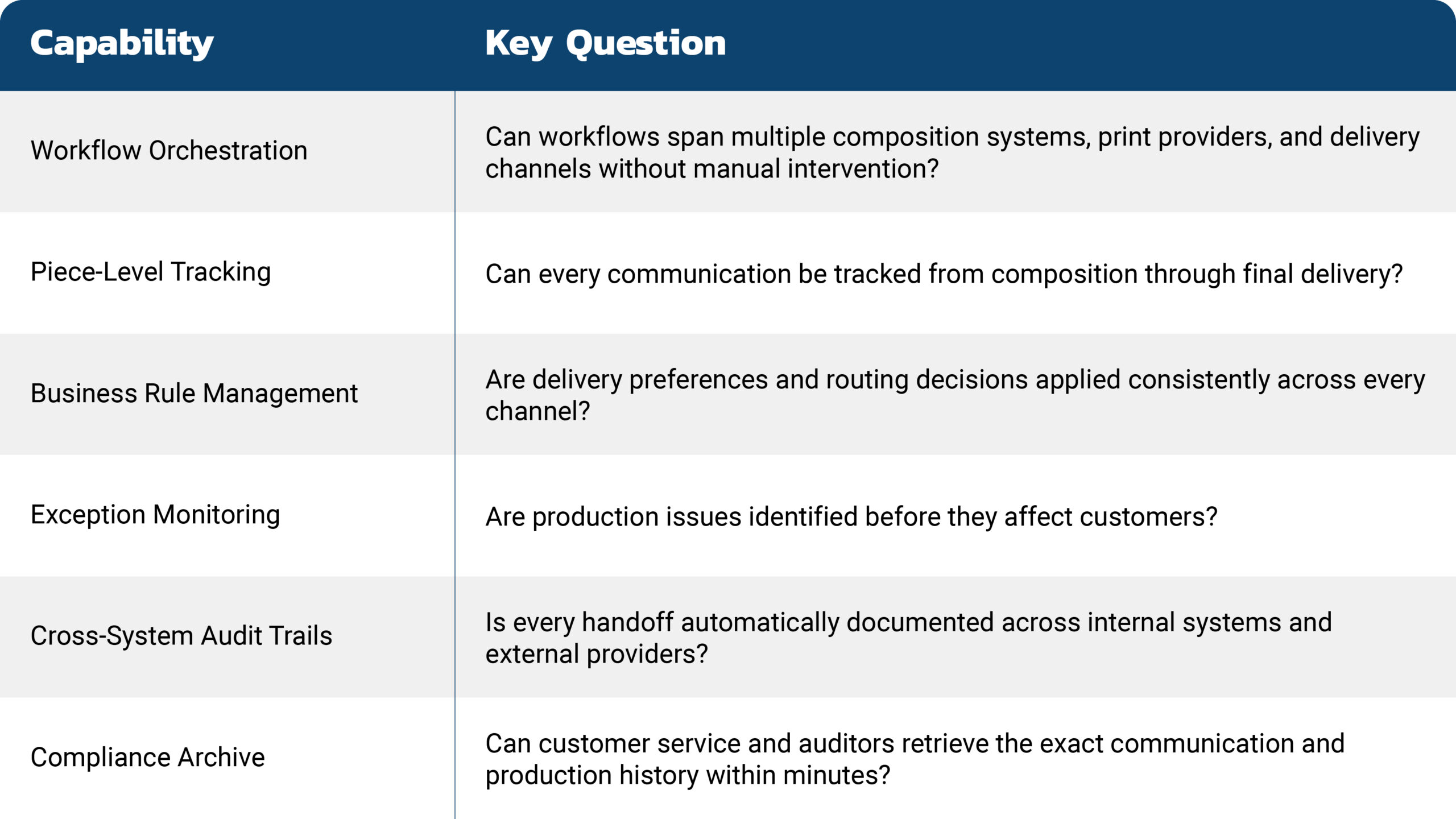
Few organizations will answer “yes” to every question immediately. The checklist is better viewed as a maturity assessment. As communications environments become more distributed, each additional production system or vendor increases the value of centralized governance.
A hybrid sourcing strategy succeeds only when operational control remains centralized, even as production becomes increasingly distributed.
When an Independent Control Layer May Not Be Necessary
Not every organization requires a sophisticated orchestration platform, and it’s important to recognize where a simpler approach is sufficient.
Organizations with low communication volumes, a single production environment, and minimal regulatory obligations may operate effectively using native reporting tools provided by their print software or service provider. Likewise, companies that produce mostly marketing collateral or other non-regulated communications may not need piece-level tracking across every workflow.
The picture changes when communications become business-critical.
Organizations in industries such as insurance, healthcare, utilities, financial services, and government face stricter expectations around accountability, customer experience, and compliance. Missing a regulatory notice, failing to document delivery, or being unable to reconstruct a communication’s production history can create financial, legal, and reputational consequences that far outweigh the investment in better operational visibility.
The goal is not to implement technology for its own sake. It’s to match governance capabilities to the level of operational risk.
The Future of Hybrid Sourcing Is Controlled Execution
Hybrid production is no longer an emerging strategy. For many enterprises, it has become the standard operating model.
Organizations want the flexibility to leverage multiple print providers, regional production facilities, cloud-based communications platforms, and digital delivery channels without sacrificing consistency or compliance. That flexibility is a competitive advantage, but only when supported by centralized operational governance.
The organizations best positioned for the future are not those attempting to own every production asset. They are those that separate operational control from physical execution.
Production may take place across multiple facilities, vendors, and delivery channels. Operational control, however, should remain centralized.
As customer communications continue to evolve, enterprises will likely add new delivery channels, adopt additional automation, and work with more specialized service providers. Without a centralized orchestration strategy, every new integration introduces another point where visibility can be lost.
Maintaining a single operational framework allows organizations to adapt without rebuilding governance every time technology changes.
From Governance Strategy to Operational Execution
An independent orchestration layer doesn’t replace composition software, print management systems, or production partners. Instead, it provides a consistent operational layer across the entire communications lifecycle.
Rather than relying on each platform or vendor to provide its own reporting, organizations establish a centralized governance layer that coordinates workflows, applies consistent business rules, and captures an unbroken audit trail from composition through final delivery.
A mature communications governance strategy typically includes:
- Centralized workflow orchestration across internal and external production environments
- Piece-level tracking throughout the communications lifecycle
- Consistent business rules applied across print and digital delivery channels
- Real-time exception monitoring and operational dashboards
- Searchable compliance archives that support customer service and audit requests
- Flexible integration with existing composition, print, and mailing systems
Several technology approaches can support this model, including workflow orchestration platforms that operate independently of production systems. Platforms such as Racami’s Alchem-e are designed to support this approach. Rather than replacing existing investments, Alchem-e serves as an operational control layer that connects distributed production environments while giving organizations centralized visibility into workflows, production status, and compliance reporting.
This allows enterprises to continue working with the vendors and technologies that best meet their production requirements while maintaining ownership of governance, reporting, and customer experience.
The objective is to provide organizations with consistent operational visibility across every stage of the communications lifecycle while preserving the flexibility that hybrid production provides.
Conclusion
The debate over insourcing versus outsourcing has become increasingly outdated.
Today’s communications environments are too distributed, too interconnected, and too heavily regulated for sourcing decisions to focus solely on where production happens.
The more meaningful question is whether the organization retains visibility into every communication throughout its lifecycle.
Hybrid sourcing delivers flexibility, but that flexibility only creates value when organizations can maintain visibility across the communications lifecycle.
Organizations don’t have to choose between operational flexibility and governance. With the right orchestration strategy, they can continue to leverage specialized production partners while maintaining complete visibility into every communication they send. In an increasingly distributed communications environment, centralized governance isn’t simply an operational advantage. It’s becoming a business requirement.
The organizations that thrive in hybrid communications environments won’t be those with the fewest vendors or the newest technology. They’ll be the ones that maintain visibility, consistency, and accountability across every communication they produce.
Physical production may be distributed across multiple providers, but accountability should always remain with the organization.
FAQs
What is hybrid print and mail sourcing?
Hybrid sourcing combines internal communications operations with external print providers, mailing partners, and digital delivery platforms to improve flexibility and scalability.
Why isn't vendor reporting enough?
Each vendor typically reports only on its portion of the workflow. Organizations remain responsible for maintaining a complete operational record across every system involved in producing regulated customer communications.
What is an independent control layer?
An independent control layer coordinates workflows across existing systems while providing centralized visibility, piece-level tracking, exception management, and audit-ready reporting.
Which organizations benefit most from centralized orchestration?
Organizations operating in highly regulated industries, including healthcare, insurance, financial services, utilities, and government, often benefit the most because customer communications frequently carry legal or compliance obligations.