Every shop has a version of this story.
A client calls. A customer service rep needs an answer. Someone in operations gets pinged. A production manager checks one dashboard. Another person pulls a report. Someone else checks whether the file was archived. Five minutes later, the room has three partial answers and no real confidence.
Then the same sentence comes out again.
“Where’s my document?”
It sounds like a small question. It isn’t.
It is one of the clearest signs that the operation has a visibility problem, and those problems are expensive.
This is not just a status lookup problem
If it were, most teams would have solved it years ago.
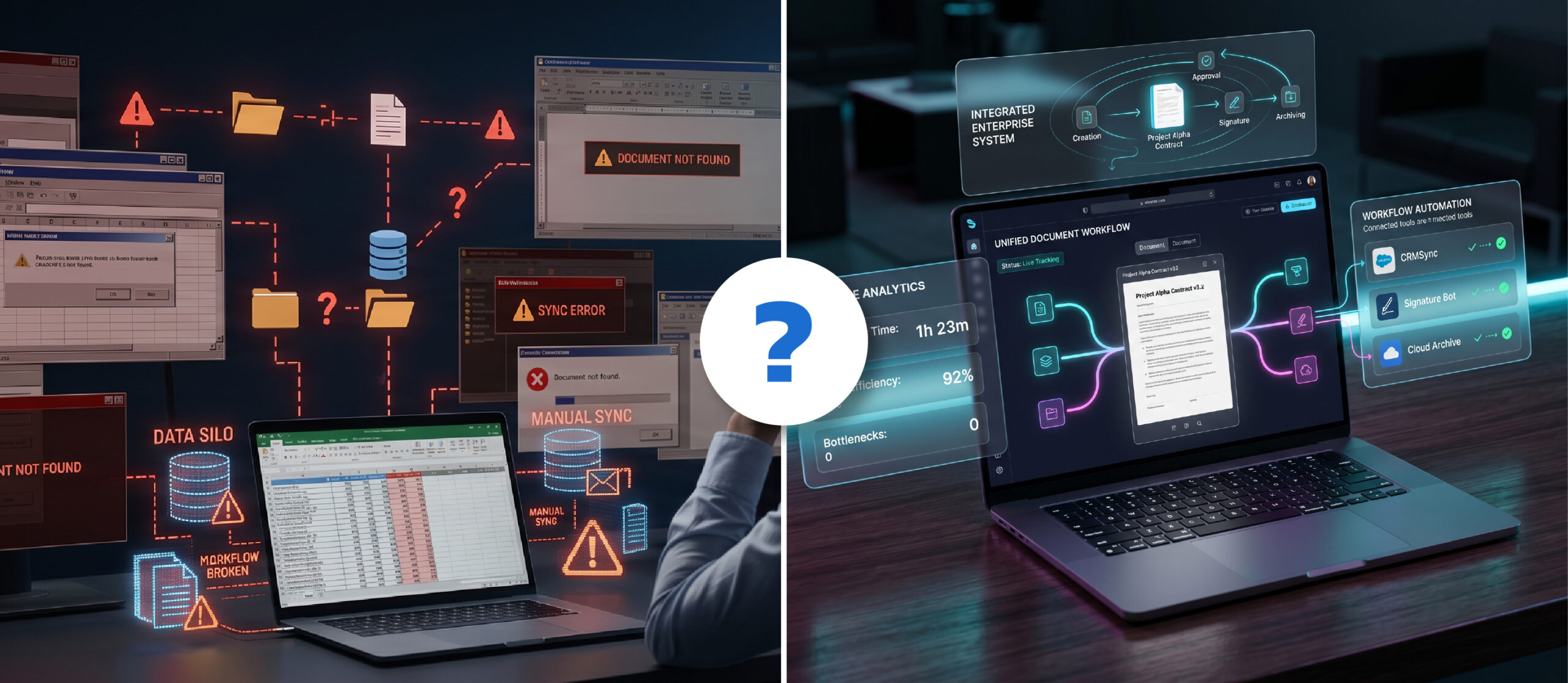
The reason it persists is that the question spans too many disconnected systems. One platform confirms the file arrived. Another shows the print stream was prepared. Another tracks job release. Another holds inserter data. Another stores the archive copy. Another feeds the portal. Another updates the CRM for the service rep.
Each system knows a piece. None provides the whole picture.
No single view. No shared truth. No quick answer.
That’s the real issue: the communication moves through the process, yet the process fails to expose usable visibility for the people who need it. Operational tracking and measurement is what’s missing.
The hidden cost of not knowing
Teams often underestimate how expensive this gets.
-
- Labor cost: Staff stop their work to chase status. On average, employees spend 20–40% of their time searching for or correcting document-related issues — that’s nearly 12.7 minutes wasted per document in manual workflows.
- Management drag: Supervisors get pulled into escalations that should never exist. Mid-sized organizations processing 50,000 documents annually burn 10,000+ labor hours on manual workflows.
- Customer cost: Delayed answers erode trust. Reprints multiply when confidence is low, service teams sound uncertain, and compliance teams burn time reconstructing events. Manual error rates average 1–3%, with each mistake costing $25–$150 to fix.
- Compliance risk: Audit failures rise sharply in manual environments — research shows a 340% higher risk of audit failure, with compliance costs averaging $85,000–$250,000 annually.
And then comes the operational cost nobody likes to admit. These are all signs that stronger advanced print management software is needed.
When an organization cannot answer where a document is, it signals that the workflow carries more manual risk than leadership realizes. Manual processes scale linearly with volume, creating a 2.5x cost increase every time document volume doubles.
Somebody is stitching together the truth by hand.
That is not control. That is dependency.
Minutes
wasted
Employees lose focus as 20–40% of their time vanishes chasing documents
labor
hours
Mid‑sized in‑plants burn this time each year keeping manual workflows alive
customer cost per error
Reprints, delays, and lost trust stack up fast when each mistake costs $150
risk of audit failure
Manual workflows inflate compliance costs and triple audit risks
The print and digital split made it worse
Years ago, “Where’s my document?” might have meant one thing: did the mail piece make it through production?
Now it can mean a dozen things.
Did the file get received? Was it re-engineered? Was it batched? Was print suppressed? Was the digital version rendered? Did it post to the portal? Is the archive copy there? Did the customer preference logic fire correctly? Did the piece get rerouted to another site? Did the CRM get the status update? Did the service team get access to the right record?
This is the reality of modern customer communications. The lifecycle is wider, the number of systems is higher, and the pressure for fast answers is greater.
That reality breaks down old status models.
Good people can keep a bad system alive for a long time
This is part of what makes the problem so slippery.
A lot of organizations have smart, hardworking people who know how to compensate for weak visibility.
They know which report to pull. Which production queue matters. Which archive path to check. Which operator to call. Which exception logic always causes trouble. Which client likes updates in a certain format.
In other words, the team acts as the integration layer, but the system fails once those people are overloaded, out of office, or gone. Then the same operation that looked stable suddenly looks fragile.
This is one of the reasons workflow visibility matters so much. It reduces the amount of truth that lives only in people’s heads.
What better visibility actually looks like
Better visibility is not a prettier dashboard alone.
It means the organization can answer practical questions without improvising:
-
- Was the job received?
- Was it transformed?
- Was it held or released?
- Was it combined with other work?
- Which facility handled it?
- Which device processed it?
- Was a digital version produced?
- Was the archive copy stored?
- Can customer service retrieve it?
- Did downstream systems receive the metadata they needed?
That kind of visibility changes how the operation feels.
Teams isolate issues faster, move exceptions more quickly, sound more confident in service, handle compliance requests with less pain, and leadership can finally see where the real bottlenecks are instead of guessing.
This is where orchestration matters
You do not get that level of visibility by accident.
You get it when the workflow layer is designed to do more than shuffle files.
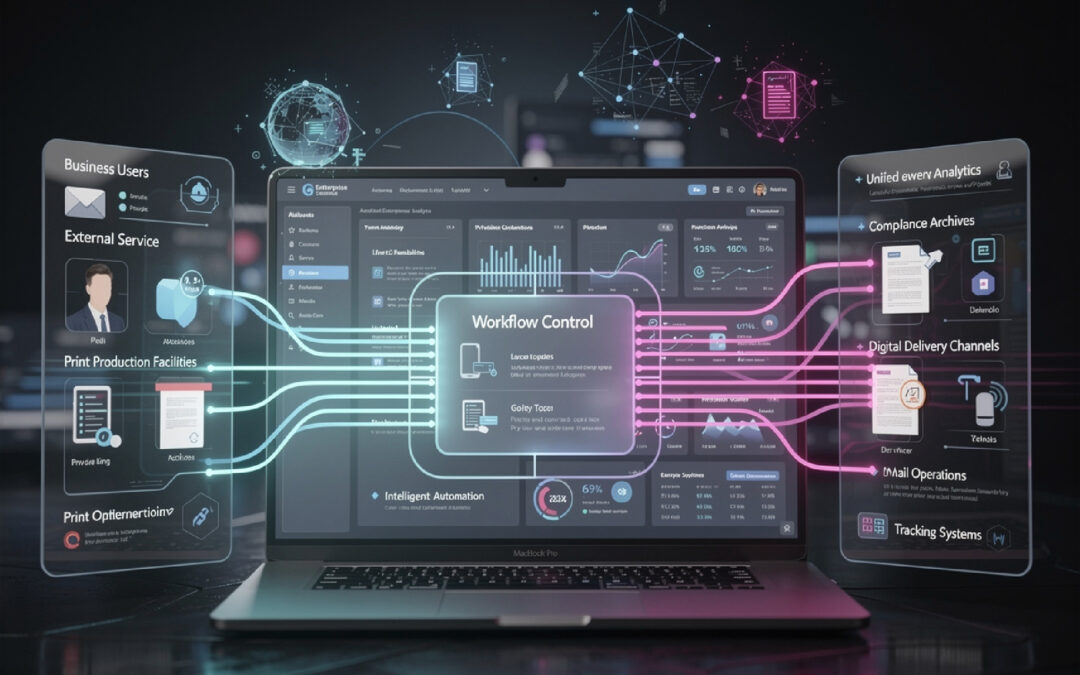
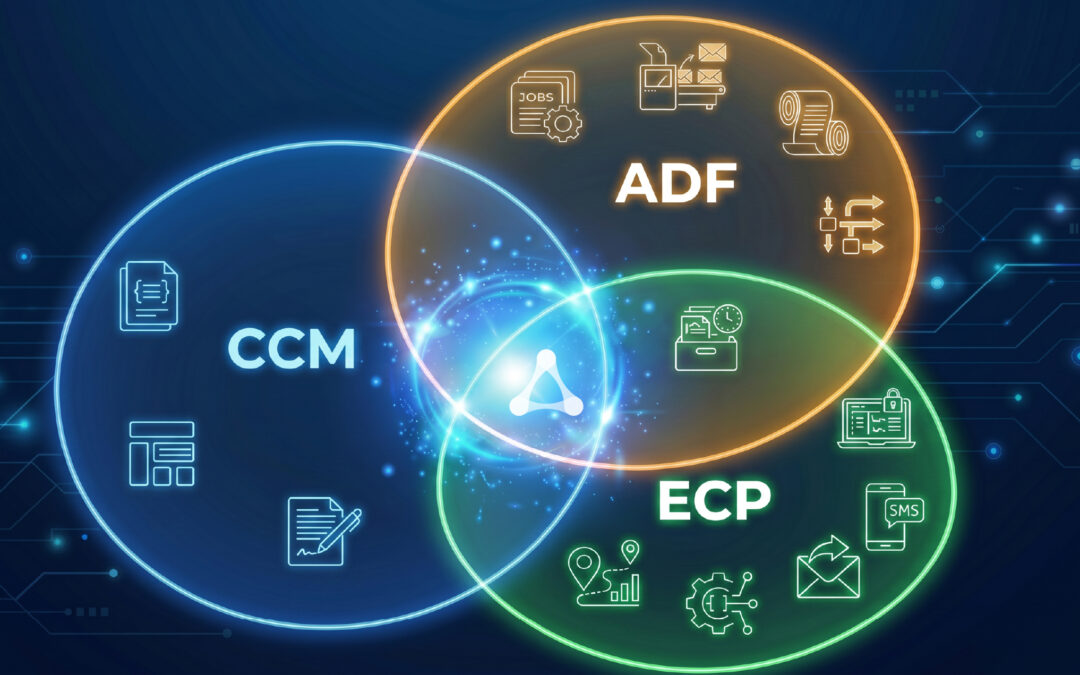
This is where orchestration earns its keep. A serious ADF and ECP‑style platform coordinates workflows across print, digital, archive, and supporting systems while preserving enough status intelligence to make the process explainable.
That last word matters. Explainable.
Because when a client, auditor, account manager, or service rep asks what happened, the operation should not have to tell a detective story.
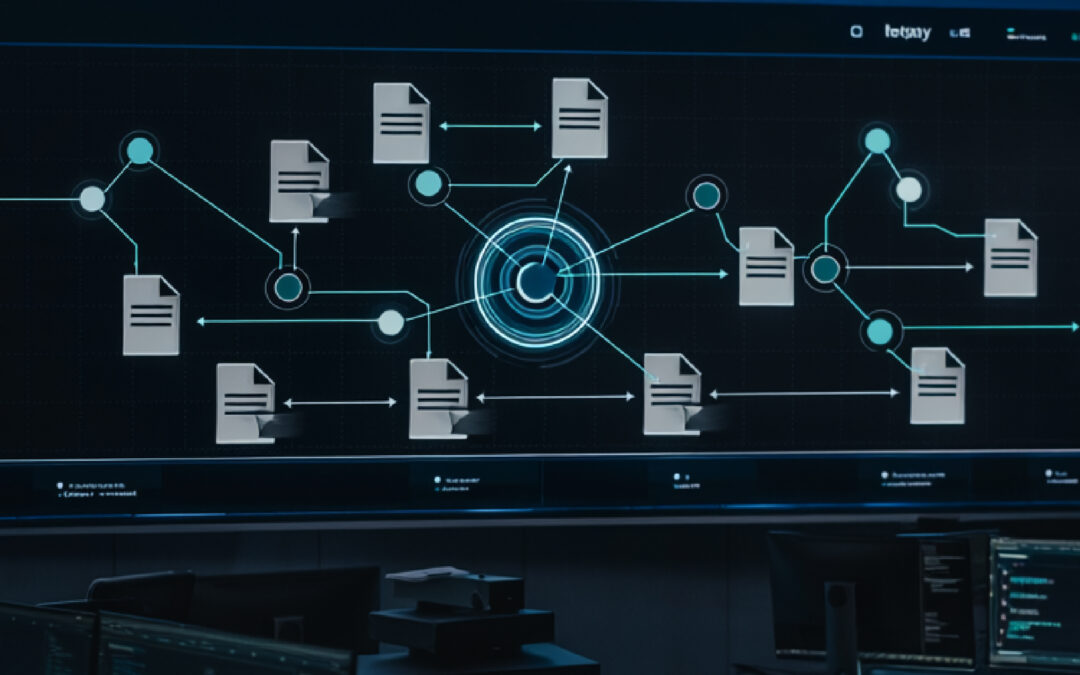
It should be able to show a documented path.
Why post-composition belongs in this conversation too
At first glance, post-composition might sound like a separate issue.
It isn’t.
The more flexibility you have after composition, the easier it is to standardize workflows, add control logic, improve traceability, and prepare files for clean downstream handling. Barcodes, page controls, redactions, indexing, data enhancements, and layout adjustments modify documents and strengthen workflow management. They make the workflow easier to manage and easier to monitor.
That is one reason document re-engineering has real operational value. It helps teams make already-composed files work better inside a controlled production process without sending every change back upstream.
The challenges described earlier, fragmented systems, broken status models, and hidden operational costs, all point to the same conclusion: visibility is the missing layer. That is the space Alchem‑e occupies.
Alchem‑e persuades best when framed around control and transparency rather than softened into generic CCM language. It connects systems that were never designed to work together, orchestrates workflows, and monitors production so efficiency improves and manual risk declines. It extends lifecycle visibility through archive support and external integrations, while enabling post‑composition changes that give teams flexibility without destabilizing upstream processes. It enforces more disciplined movement from development to testing to production, and it strengthens confidence with job‑level validation, piece‑level status, and safer promotion of change. Most importantly, it gives operations teams meaningful control without turning every adjustment into a core‑system project.
That is a much more believable answer to the “Where’s my document?” problem.
Because the right answer is not just a faster lookup.
It is a better operating model.
Final thoughts
The next time someone asks where a document is, it is worth pausing before treating it like a one-off request. That question is doing you a favor.
It shows exactly where the workflow loses visibility, and wherever visibility disappears, cost appears. Sometimes as labor. Sometimes as delay. Sometimes as rework. Sometimes as risk. Usually as all four. That is why this is still a million-dollar problem. Not because one document went missing.
Because too many operations still cannot see the full truth of what happens after a communication is created.
The opportunity is to stop treating “Where’s my document?” as a nuisance and start treating it as a signal. It points directly to the gaps that need fixing. Organizations that act on those signals build stronger operating models, reduce hidden costs, and restore confidence in their communications.
If you’re ready to explore how visibility can be restored, it is time to look at solutions designed for control, transparency, and orchestration.
FAQs
Why is “Where’s my document?” such a costly question?
Because the question usually exposes larger workflow gaps. When teams cannot quickly see document status across production, archive, digital delivery, and service systems, labor goes up, answers slow down, rework increases, and risk grows.
What causes poor document visibility?
Common causes include disconnected systems, manual handoffs, missing metadata, siloed archive and production environments, weak integration, and overreliance on tribal knowledge.
What should end-to-end document visibility include?
A strong visibility model should show when work was received, transformed, batched, released, delivered, archived, and exposed to downstream systems. It should also support exception handling and auditability.
How does post-composition help with visibility?
Post-composition tools can add barcodes, page controls, indexing, and other workflow enhancements that make documents easier to track, standardize, and manage downstream.
How can Alchem-e help solve this problem?
Alchem-e supports orchestration, tracking, post-composition changes, archive-related workflows, and integration with other systems, which helps organizations improve visibility and reduce the manual effort required to answer document-status questions.